Check the package
LiDAR host, gateway, host-to-gateway cable, Ethernet cable and power supply; listing states approximately 3 kg total package weight.
Confirm delivery →LIDAR
192-line single-photon LiDAR · 300 m maximum range · 200 m at 10% reflectivity · 120° × 25° FOV · 1,536,000 points/s
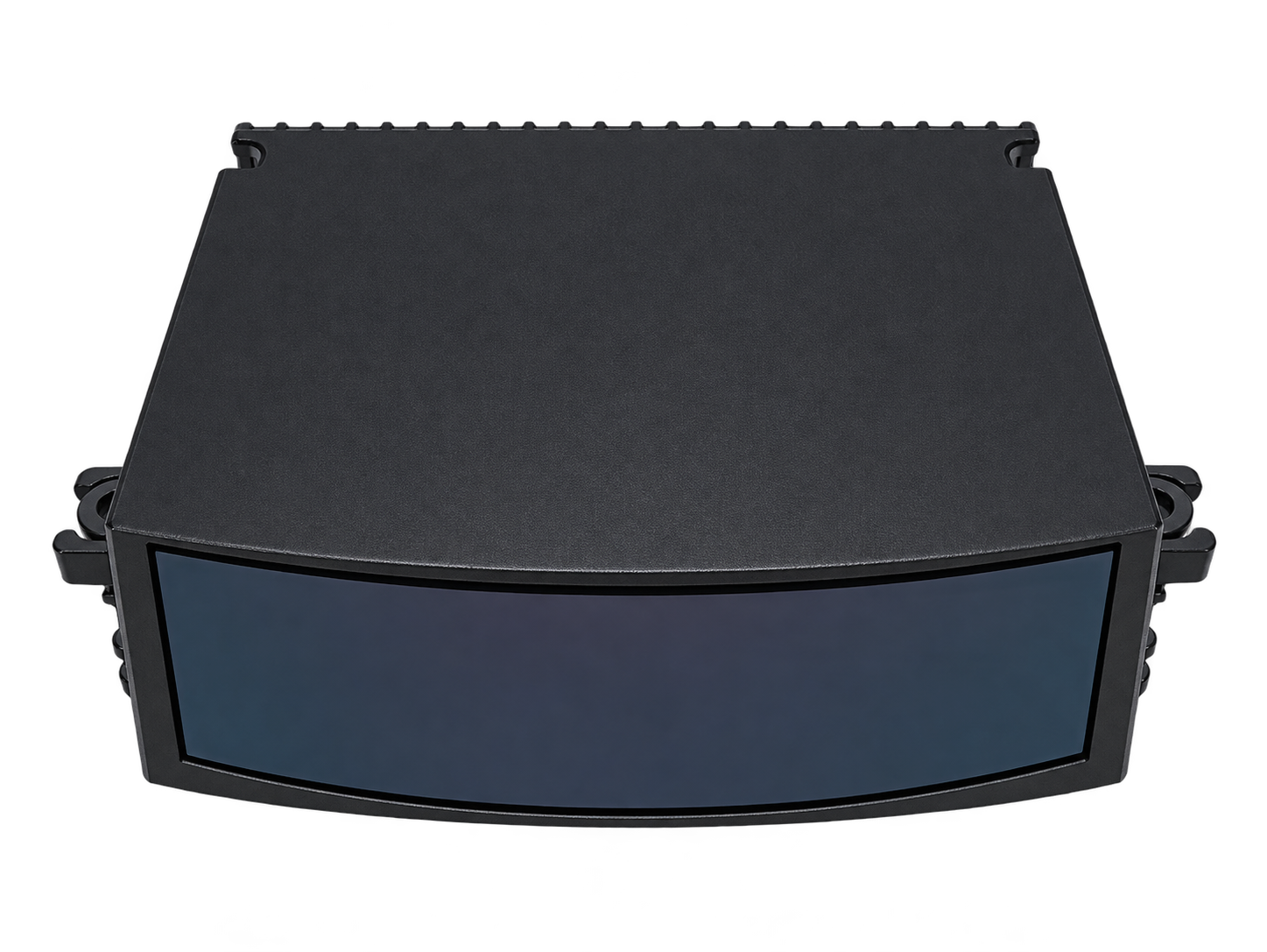
Check included items, availability and delivery before placing your evaluation order.
Model-specific values and test conditions.
| Parameter | Published value / condition | Ref. |
|---|---|---|
| Channels / type | 192-line semi-solid-state, single-photon dToF | 1.0 |
| Range | 300 m (200 m @10% reflectivity), 1 m min · 200 m at 10% reflectivity under 100 kLux; 300 m is maximum range. | 1.0 |
| FOV | 120° (H) × 25° (V) | 1.0 |
| Resolution | 0.15° × 0.13° @10Hz | 1.0 |
| Point rate | 1,536,000 points/s | 1.0 |
| Accuracy (1σ) | < 3 cm · Lambertian 10% target at 20 m. | 1.0 |
| Frame rate | 10 / 20 Hz | 1.0 |
| Returns | Single / dual echo, anti-interference | 1.0 |
| Safety | Source lists ASIL-B and "Class 1B"; classification / certificates TBD · Reference claim only; verify final product label and formal documentation. | 1.0 |
| Time sync | 1588v2 PTP / 802.1AS gPTP / PTP Master | 1.0 |
| Environment | −40~85 °C · IP67, IP6K9K | 1.0 |
| Power | DC 9~32 V · 10 W | 1.0 |
| Size / weight | 125 × 110 × 35 mm · 808 g | 1.0 |
| Connector | TE 2387351 | 1.0 |
| Sensor-side data | 1000BASE-T1; specified gateway / interface box · Source PDF p.7 | 1.0 |
| Storage temperature | -40 to +95 deg C | 1.0 |
| Mass boundary | 808 g host only, excluding cable; enclosure excludes mounting / connector | 1.0 |
| Cable | Diameter 4.10 +/-0.2 mm; minimum bend radius 5 x diameter | 1.0 |
| Host IP / PC example | 192.168.101.101 / 192.168.101.200; subnet 255.255.255.0 | 1.0 |
| Signal / item | Source reference | Ref. |
|---|---|---|
| 1 | VCC, DC 9-32 V | 1.0 |
| 2 | WAKEUP input; original pin table labels 0-30 V; switching threshold / timing: TBD | 1.0 |
| 3 | GPSRMC, 3.3 V CMOS | 1.0 |
| 4 | Power GND | 1.0 |
| 5 | Signal GND | 1.0 |
| 6 | PPS, 3.3 V CMOS | 1.0 |
| D1 | 1000BASE-T1 positive | 1.0 |
| D2 | 1000BASE-T1 negative | 1.0 |
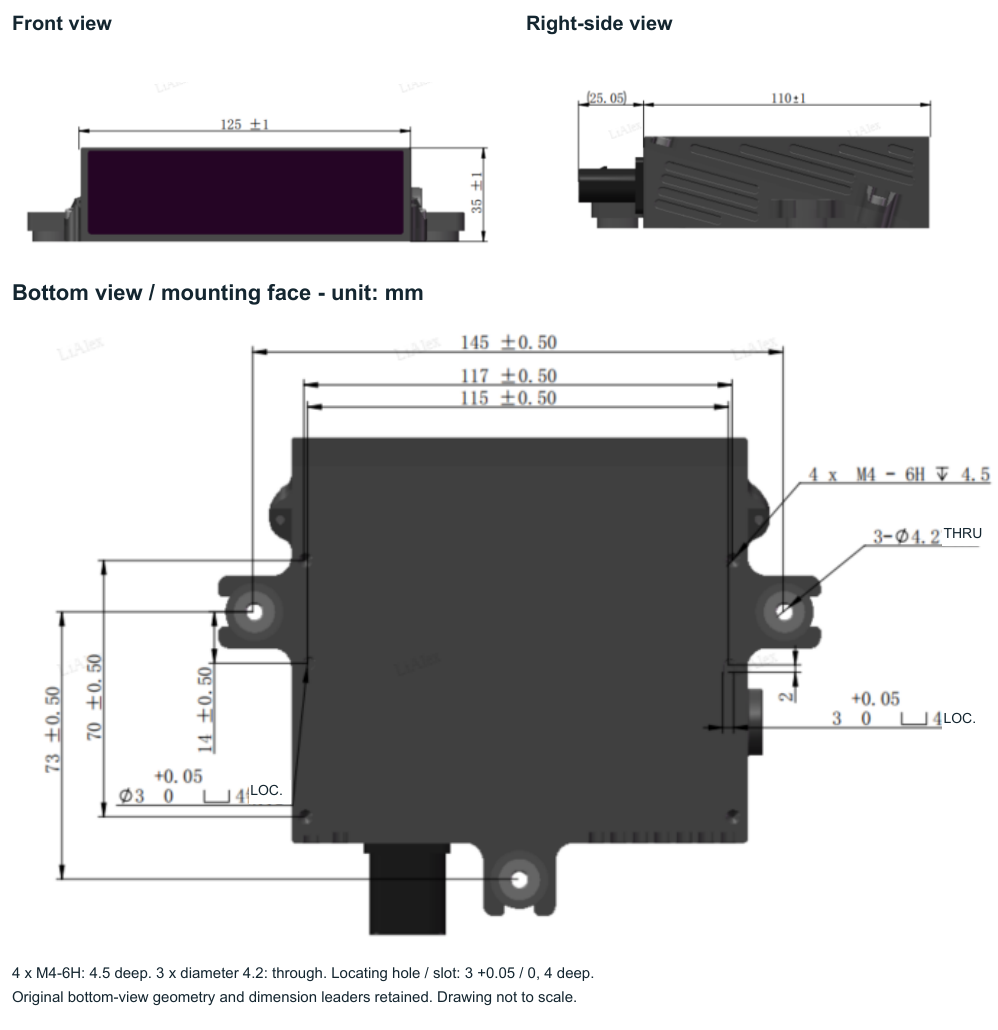
Units: mm. Source dimensions only; unavailable details are TBD.
| Item | Published value / condition | Ref. |
|---|---|---|
| Host body | 125 +/-1 x 110 +/-1 x 35 +/-1 mm; body excludes mounting / connector | 1.0 |
| Mounting / base callouts | 145 +/-0.50; 117 +/-0.50; 115 +/-0.50; 73 +/-0.50; 70 +/-0.50; 14 +/-0.50 mm, datums per original drawing | 1.0 |
| Mounting holes | 4 x M4-6H threaded holes, depth 4.5 mm; 3 x diameter 4.2 through holes | 1.0 |
| Locating features | Diameter 3 (+0.05 / 0) and width 3 (+0.05 / 0), each 4 mm deep; 2 mm edge callout | 1.0 |
| Sensor connector | Mounting plate 23.6 x 21.5; mounting pitch 18.9 x 16.8; diameter 2.3 mm holes | 1.0 |
| Optional interface box | 100 +/-0.50 x 80 +/-0.50 x 28 +/-0.50 mm; 88 +/-0.20 mm mounting pitch; 2 x M4, depth 8 mm | 1.0 |
| Host mass / cable | 808 g excluding cable; cable diameter 4.10 +/-0.2 mm; minimum bend radius 5 x diameter | 1.0 |
| Capability | How it is provided |
|---|---|
| Device interface | Refer to model-specific documentation |
| MQTT | Acquisition and gateway integration available; model-specific scope to agree |
| OTA | Firmware and update lifecycle services available; compatible device scope to agree |
LiDAR host, gateway, host-to-gateway cable, Ethernet cable and power supply; listing states approximately 3 kg total package weight.
Confirm delivery →Specifications, dimensions, interface notes and available SDKs.
View documents →ROGERSENSE S1 is a 192-line semi-solid-state LiDAR using single-photon direct time of flight. Its maximum range is 300 m; the documented 200 m range at 10% reflectivity is specified under 100 kLux sunlight. Rated field of view is 120° horizontally and 25° vertically.
The transmitter emits an ultrashort pulse and the receiver detects the target reflection. Range is calculated as d = c × t / 2, using the round-trip flight time t and the speed of light c.
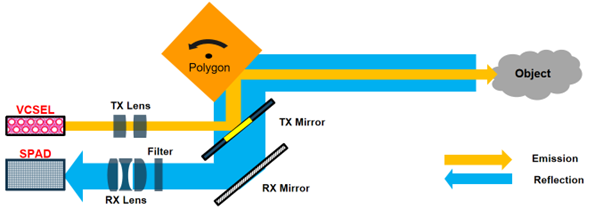
Eight line-type VCSEL emitters form a line spot. The optical design covers 25.6° vertically; the rated product field remains 25°. The mirror runs at 150 rpm at a 10 Hz frame rate to scan a 120° horizontal field.
The sensor uses a TE 2387351-series hybrid connector. D1 and D2 carry the positive and negative signals of a 1000BASE-T1 link. Use the matching harness and gateway to connect to an ordinary host Ethernet port.
The gateway front face provides LAN, timing and DC input. Its rear face provides T1 ETH, status LEDs, DIP settings and power output. These are opposite faces of the same gateway. Included accessories follow the ordered configuration.
Host body: 125 ±1 × 110 ±1 × 35 ±1 mm, excluding mounting features and connector. Optional gateway: 100 ±0.50 × 80 ±0.50 × 28 ±0.50 mm. Detailed mounting dimensions and connector drawings are provided in the approved 20-page specification.
Document version 1.0. Unavailable details remain TBD. Certification and test evidence are confirmed for the delivered configuration. MQTT, OTA, gateway and cloud integration are ROGERSENSE services with model-specific adaptation agreed per project.
No reviews yet.
